By Richard Hang Hong
Whether it be taking your driving test, a school exam or in this case, attempting your black belt, taking any kind of test can often be a nerve-racking experience.
Remember the phrase “The 6 Ps?” Proper Persistent Practice Prevents Poor Performance. Never has a truer word been said when it comes to getting ready for your black belt.
Preparation is the key.
And that first P is so important; it must be proper practice for it to have any worthwhile effect. Just turning up to the dojo and running through the motions of the class isn’t enough. One must be actively seeking to improve the skills we have learned in training, not just practising what we already know.
The second P has a lot to do with mindset.
The mindset that a student has makes a great amount of difference to how they apply themselves at this time too. Not taking their training seriously enough means that the student doesn’t prepare themselves properly and therefore never becomes truly ready to take the test. This is something we see a lot of when students reach brown belt.
At this point it’s very easy for students to become complacent and comfortable where they are, and to take that extra step to break through that glass ceiling can be too daunting for some. I believe that this may be why so many 2nd and 1st kyus quit before they get to black belt, they don’t have the mental toughness to push themselves to that level.
Last year, up to 45% of university and other higher education students dropped out before completing their degrees. There are close similarities in numbers between this and the dropout rate of brown belts. In the last 15 years, I’ve seen countless numbers of students with all the potential to reach black belt quit. In the vast majority of these cases, it boils down to whether or not that student is strong enough to do what it takes. Throughout the brown belt levels, a student gets tested mentally and emotionally, going through many highs and lows. It’s the ability to persevere, to push through the low times, especially when they reach the point of wanting to quit, that makes the student mentally stronger when they get to the other side.
The third P, Practice, is essential.
Without putting the time in on the dojo floor, one can never hope to be ready. The amount and regularity of training make a huge difference to both a student’s progress and their motivation in the lead-up too. On average, in our club, it takes about 100 hours/classes and a year of training as a 1st kyu to reach the technical standard required for a black belt. In order to fit this into the time frame, a student should be training 2 – 3 times a week. Repetition is the mother of skill, but it’s not just the hours you put in, but what you put into the hours that count too. 10 hours/classes of running through the motions are only worth about 1 or 2 hours/classes of intense, focused and diligent training, and that’s being generous. Yes, it’s easier to take breaks and plod along comfortably, but nothing worthwhile is ever meant to be easy is it?
So by training properly, regularly and often, a student should be improving at a steady pace, therefore keeping motivated along their journey. I rarely see a brown belt quit who is training like this, although there are rare exceptions, the vast majority who drop out are only training once a week and I’ve yet to see one of them reach black belt level.
In any good quality club or association, achieving a black belt should be a challenge. One that takes the student out of their comfort zone and makes them a better karateka, therefore giving value to the black belt. I don’t agree with black belts being awarded just because someone has done their time or because the examiners don’t want to upset the student. At the end of the day if you’re not up to standard you shouldn’t be given one.
So if you’re serious about wanting to be a black belt, do the right training, develop the right attitude and apply yourself, you’ll get there, provided you have what it takes.
Osu
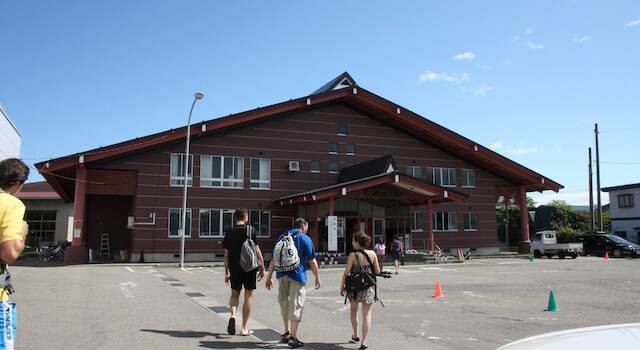

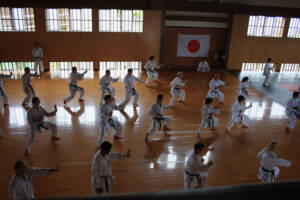 Training with the Japanese Sensei in Japan is quite different from training with them when they come to England. Not necessarily in how you train as you still put in just as much effort, but more from how they teach. When Fujiwara Sensei comes to the UK, the seminars have a wide range of students. Most of them are brown and black belts, but there will also be a number of lower kyu grades that attend so to make sure that everyone gets something out of the seminar, the level of detail is spread across all of those who are participating. However, in Japan I only saw one or two brown belts, both of whom were 1st kyu and were also taking their shodan tests during this trip. Everyone else was a yudansha (black belt), ranging from Shodan (1st Dan) to Nanadan (7th Dan), and the vast majority of these black belts were instructors too. Because of this, Fujiwara Sensei made a point of focusing the training to black belt level and directing a lot of the content towards instructors. Seeing the difference in standards and progression at these high levels was still very clear and it didn’t take long to figure out what level each person was. Nobody had any bars on their belt to say what Dan grade they were, you showed your level by how hard and how well you trained and how much you showed your understanding of the techniques and principles of what was taught, as well as being able to perform them too.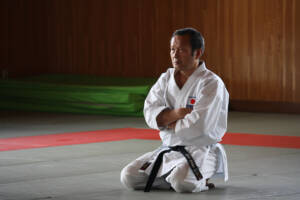
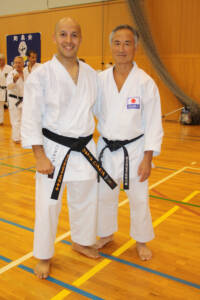 After the first hour or two was over we were split into groups to work on our kata. I got to train with Takegawa Sensei, who out of all the Japanese sensei, had the best English, so understanding what was being taught became a lot easier. We studied the bunkai in great depth and I had the pleasure of being picked as his uke which I was told was a good sign that I was training well and he was pleased with how I was doing.